Showing posts with label Bram Stoker. Show all posts

Wednesday, August 7, 2013

Happy Birthday The Blood Countess: Erzsebet Báthory (1560-1614)


 File:Elizabeth Bathory Portrait.jpg

Countess Báthory is said to have bathed in the blood of 650 young girls, all of whom she tortured, murdered and drained their bodies of blood to retain her youth.  Reputed to be a vampire, a lesbian and a witch, her story inspired the Brothers Grimm, Bram Stoker, and Gothic horror fans for the past four hundred years. Legend has it she was the most prolific serial killer in history.

On August 7th, 1560, the daughter of Baron George Báthory and Baroness Anna Báthory was born. They named her Erzsebet (anglicized name is Elizabeth). George and Anna were both Báthorys by birth and from one of the most powerful Protestant families in Hungary. Erzsebet was highly-educated -- fluent in Hungarian, Latin and Greek -- during a time when most Hungarians of noble birth were illiterate. Growing up, Erzsebet witnessed the brutal punishments executed by family's officers on their estates at Ecsel.  When she was six, one story reports, a gypsy who was accused of theft was sewn up in the stomach of a horse sliced open, with his head exposed and left in this position to slowly die.


At the age of eleven, she was engaged to František (Ferenc) Nádasdy who was a nobleman and captain of the Hungarian army, and moved to Sárvár and Kereszstúr castles to live with her mother-in-law until her marriage. 


In 1575, she married Ferenc. As a wedding gift, he bought her Čachtice Castle in western Slovakia. Often times her husband -- chief commander of the Hungarian troops in the war against the Turks  -- was gone for long periods of time. It was said he was feared and that he danced with the dead bodies of Turk soldiers, throwing their decapitated heads up in the air after battle.  He taught Erzsebet new ways to reprimand servant girls -- pour honey over their bodies and leave them outside for the insects to creep all over and wasps to sting them. He also left her with iron torturing devises he used in battle to exercise on her servants.

While her husband was gone, Erzsebet managed the affairs of the Castle.  It was here that Erzsebet's thirst for evil supposedly began -- she cruelly disciplined her large household staff, especially the young girls beating them with a barbed lash or a heavy cudgel, she cut the skin between their fingers, and dragged them naked into the snow dumping cold water on their bodies until they froze to death. It is said that she suffered from seizures accompanied by loss of control and fits of rage. Once so angry at a young servant girl, she grabbed her jaw and ripped it from the bone.

In 1604, her husband died. Records show more and more young peasant girls went to work in the castle were disappearingShe was extraordinarily powerful. She became more sadistic. She had no supervision. She was isolated. Her mental state was rapidly deteriorating. Erzsebet was now 43 and her angelic complexion had faded.  This, it was said, put her into a tempestuous rage. One night, a maidservant combing her hair, pulled out some strands. Enraged, Erzsebet hit her in the face, blood splattered all over her arm. Wiping it away, she noticed how soft and smooth her skin was. She consulted with alchemists and they too agreed blood was an elixir of youth.  If nature was going to steal her youth, she would take it back from the young.

Legend says that Erzsebet began capturing and torturing young girls -- particularly virgins between the ages of 10-14.  She lured girls to work for her and ordered her servants to nab girls off the streets from surrounding villages and lock them in the dungeon. There, she attacked them with knives, burned their private parts with a hot iron, and stuck pins underneath their fingernails before cutting off the digits of those who resisted. She cut areas of flesh from their bodies and forced them to eat it. Shoved in small cages and slowly impaled with spikes. Some, it was said, were hung upside-down by chains round their ankles, naked and still alive. Their throats slit and blood drained for Erzsebet's bath. When the Countess was too tired and retired to bed, girls were brought to her bedside so she could bite out pieces of flesh from the their shoulders, cheeks and breasts.

Erzsebet eventually became careless moving to the nobility for her victims. Four drained bodies were thrown from the walls of the castle.  Peasant girls were one thing, but noble girls were vastly different. Church records show an inordinate amount of deaths of young girls. Word reached Matthias II. And in 1610, an investigation was launched. Troops were sent, dead and mutilated tortured bodies were found strewn about the castle. An official inquiry of 300 witness statements were taken. Her aristocratic status meant she could not be arrested and executed. Her maidservants and accomplices were not so lucky. They had all their fingers pulled out by red-hot pincers, they were tortured and their bodies thrown alive into a fire.

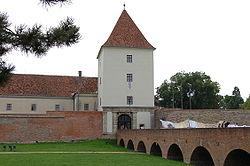
File:Hrad Cachtice.jpg

She was never convicted of any crime. But to remove her from power, she was walled up within her bed chamber with only small slits for ventilation; and occasionally the passage of food. 

After three years, a guard looking through one of the slots saw the Blood Countess lying face down on the floor of her chamber, dead. Erzsebet died in Čachtice Castle on August 21, 1614.

This is a result of the legend created about the life of Countess Báthory. We don't know for sure. Documents about her life disappeared. Was she a sadistic murderer? Or was this a plot to remove a women from power. Women in early 17th-century Hungary were supposed to retire and mourn after their husband's demise, but Erzsebet continued on. "You will find a man in me!" she stated in one of her letters. This threatened the reputation of her family. 

Born: 1560; Died: 1614 Countess Elizabeth Bathory is considered the most infamous serial killer in Hungarian/Slovak history. Rumors had circulated for years about missing peasant girls; offered well paid work at the castle, they were never seen again.

Considering the Countess was an unfavorable Protestant born into one of the most important and wealthiest noble families in central Europe, a woman managing ten very valuable castles estates on her own, and that the king owed her late husband a large sum of money, there was motivation to quickly remove her
  
Like other legends, the tales of the Blood Countess were shrouded with rumors. Many books and films were made of her life. Whether these stories are true or not, their appeal to a certain kind of audience remains as strong as ever.


Hungary was divided in two empires, Hapsburgs and Osmanian, the capitol city of Hungary was Bratislava. Čachtice Castle is located just northeast of present-day Bratislava, Slovakia. 

(images from wikipedia and last image of Bratislava from my iphone April 2013)

Tuesday, June 9, 2009

Vampire Killing Kit


“How then are we to begin our strife to destroy him? How shall we find his where; and having found it, how can we destroy?”


So Bram Stoker wrote in his infamous novel Dracula, published in 1897. Dracula, the compelling creature of the night, gained immortality by biting the swan-like necks of fair maidens and sucking their blood. A most terrifying figure, he was also portrayed as handsome aristocrat, well-dressed, and impeccably groomed (he was, after all, a count). He was dangerously seductive until the moment he sunk his teeth into a beautiful woman’s alabaster neck, upon which his face turned ghostly, exposing his pointed teeth and flaming red eyes. It was feared that women would invariably succumb to his charms.

The vampire is one of the most pervasive and recognizable symbols of evil in Western culture. He possesses supernatural powers; he is different than other evil monsters such as the hairy werewolf or clumsy Frankenstein. He is not easily recognizable. The image of the vampire is flexible. He can be so many different things -- a threat to society, at the same time he can serve as an enticement from our hum-drum lives. He is alluring and that kind of phenomenon, a supremely evil creature disguised as a man of charm and good breeding, has tremendous appeal in our culture. The concept is seductive.

So impressive was the impact of the vampire on certain people -- so real did he seem to be -- that people were warned to have weapons to deal with the presence of a vampire.


Steven's Auctions: Fully equipped with holy water, garlic, cross and candles, this kit sold in October 2008 for $15,000.


Elaborate kits were crafted -- wooden boxes the size of a briefcase stuffed with all the necessary accoutrements to eliminate the vampire: crucifix, bible, a pistol, silver bullets, a rosary, vessels for garlic powder and various serums that could be injected intro the vampire.

What was the origin of these objects? Some vampirists claim such kits were common in the eighteenth and nineteenth centuries, while others claim many were more likely assembled following the publication of Bram Stoker's Dracula and marketed to anxious British travelers to Eastern Europe. Forests were dense and the fog heavy in Eastern Europe. Tourists took a huge chance by going there; if they did they needed the protection.


Mercer Museum in Doylestown, PA


A Professor Ernst Blomberg’s name appears on the label of many of these kits. On it he requests that the purchaser of the kit carefully studies the kit and should evil manifestations become apparent, he is adequately equipped to deal with them efficiently. The existence of Professor Blomberg has not been confirmed. Whether the whole things was a hoax or not, it didn’t matter; the image of the vampire in Western imagination was very vivid and real.

One thing is for sure and that is these kits have been selling for a lot of money on the market.

Garth's Auctions: September 1, 2006


Why are we so fascinated with vampires? This fascination did not begin with Stoker, two centuries prior to the publication of his book; there was a hysterical rash of vampire epidemics reported in Eastern Europe. In 1704 a book entitled Magia Posthuma was published by a Catholic lawyer named Karl Ferdinand von Schertz. Von Schertz examined reports of the living dead who roamed about in Moravia and other places and harming the living. Two decades later Austrian officials were investigated a similar case that was reported in northeastern Serbia. The locals there called the mysterious figure a “vampire”.

As the decades went on more cases were reported. Local people developed several means by which they could control a vampire’s activities. The best method to neutralize a vampire was to drive a wooden stake through his heart. To be on the safe side, it was recommended that the vampire be decapitated and his body burned.

In Russia, Romania and the Balkan States, people in the eighteen century believed that the soul didn’t depart from the body it inhabited until forty days after death. They also believed that the soul could linger for years, which would delay decomposition of the body. To check on this, bodies were dug up after a period of years. If, after a certain length of time, there was no evidence of decomposition, it was believed that the corpse was that of a vampire. However, if there was evidence of decomposition, the bones were cleaned with water and wine, wrapped in linens and reburied.


Vampire kit disguised as a book. Garth’s Auctions – September 1, 2006

The vampire phenomenon caught on quickly in certain parts of Europe. By 1734, for example, the word “vampire” had entered in the English language. Those early vampires were described as frightening grotesque. Their bloated faces turned purple from drinking blood; their fingernails grew long, and their bodies exuded a horrific smell. Out of fear, knowing that vampires could appear dead when they were just sleeping, as a precautionary measure, people would dig up graves, open the coffins and ram a stake into the hearts of the corpses.

In 1755, Empress Maria Theresa sent a renowned scientist to the Slavic region to find out more about vampires. She began passed laws forbidding the exhumation and destruction of corpses. The Habsburg Empire brought the oral folklore from the Balkans and Transylvanian region to the Western mind.
Sotheby’s: April 20, 2007. Realized: $7,200


Gradually, the vampire motif began to creep into the European consciousness. It attracted the attention of artists, scientists, clergy, and scholars and of course the general population. It also caught the imagination of poets and authors of gothic fiction which by the mid-eighteenth century had become very important to middle-class Victorians. Dead corpses were believed to be able to rise through the earth; tales of this phenomenon were written down, plays were performed. By the time of the Victorian era, the fear of decomposing corpses, and all the harm they could cause, infected the society to an almost hysterical degree.


Sotheby's, New York: October 8, 2004. Estimated: $4,000-$6,000; realized price: $26,400

In it contains:
(1) An efficient pistol with its usual accoutrements
(2) Silver bullets
(3) An ivory crucifix
(4) Powdered flowers of garlic
(5) A wooden stake
(6) Professor Blomberg's new serum


Dracula represents a universal fear of premature burial, wherein a person might appear to be dead but is actually still alive. Why we still have this fascination, I am not sure, but it translates across genders and we see movies and television shows about it. One thing for sure, is vampires are always good looking, well-poised and very refined. You don’t see any hillbilly vampires.


Check out the vampire kit at Manions Internatonal Auction House.